September 17, 2026

Next step in software development cuts fuel consumption by an additional10%: Just-in-Time
sailing (JIT), with the captain in control at all times (‘Human in the Loop’)
.

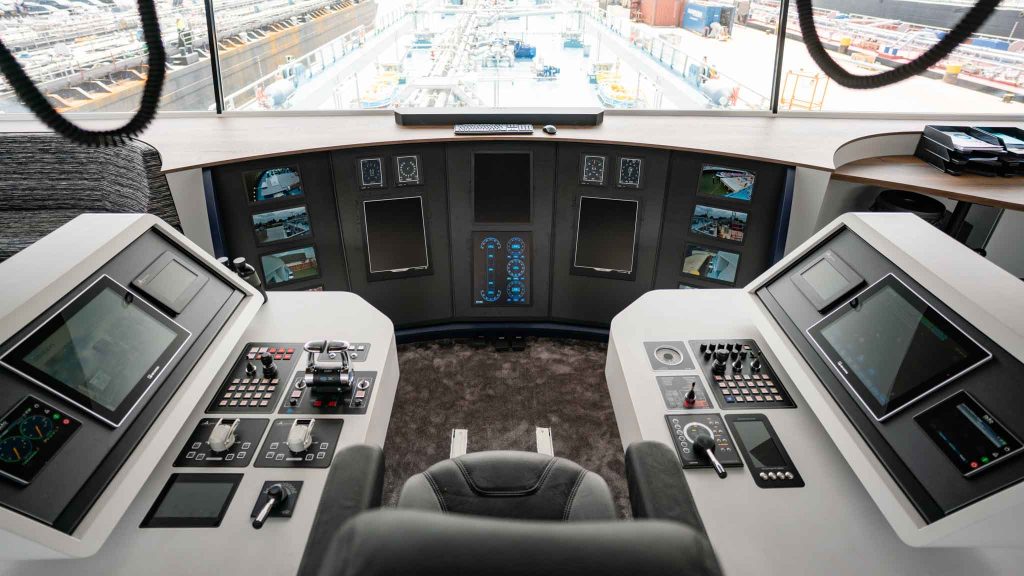
Shipping Technology has launched ST Sailing Pro, an extension of its ST Sailing track pilot that now
not only controls a vessel’s steering, but also its propulsion. This is the next, planned step in the
company’s roadmap towards autonomous sailing. In short: the captain enters a destination and a
desired arrival time, after which the system continuously calculates the course and engine power
needed to meet it – taking changes in locks, currents, water levels etc. into account. On a normal
sailing pattern, ST Sailing Pro reduces fuel consumption by a further 10 per cent on top of the 5 per
cent already validated for ST Sailing. The system operates at level 2 of the CCR automation scale,
with the captain supervising at all times.


Shipping Technology started collecting vessel data in 2018, with the ST Brain PRO onboard unit and
added automatic rudder control five years ago, and now running on 400+ vessels. ST Sailing runs on
some 200 vessels and has logged more than 315,000 sailing hours and 4.4 million kilometres. That
data set has significantly speeded up developing the next step: active propulsion control.


6 months of testing and continuing
Trials last year used a thruster-driven river cruise vessel and covered automated manoeuvring.
Testing then moved to conventionally equipped commercial vessels – main engines, reverse-
reduction gearboxes, a propeller shaft and a rudder – which make up the largest part of the inland
fleet. After six months on a single vessel under a Smart Shipping permit, trials now run across several
vessels in the dry cargo, tanker and passenger shipping markets.


How it works
Remco Pikaart, Founding Partner, Shipping Technology, explains: “The captain casts off and
manoeuvres out manually. Note that we have already automated this for thruster-propelled vessels
Then, he or she engages ST Sailing Pro and enters a destination and arrival time. The system indicates
whether that time is achievable and then adjusts course and engine power to meet it, sailing – and
this is unique – in the way a skipper would. We’ve built that into the system. Water levels, squat and
lock scheduling are part of the calculation, and the feasible arrival window can vary by up to three
hours depending on conditions. The captain validates what the system proposes, e.g. whether to
overtake, hold back, or arrive earlier or later. Also, the captain can take over at any moment. At CCR
level 2 (ed.: Central Commission for the Navigation of the Rhine), responsibility for all other sailing
tasks remains with the captain, and the onboard technical infrastructure meets regulatory
requirements taking effect on 1 January 2028. I’m very proud of my team!”

Validated fuel savings
Rijkswaterstaat (part of the Dutch ministry of Infrastructure and Water Management) validated the
5% fuel saving for ST Sailing in certified field testing. Interestingly, the additional 10% from
propulsion control is largely determined early in a voyage, in the speed chosen shortly after
departure.
Remco: “Besides creating added value on ship data for shipowners and fleetmanagers via the ST
Brain Pro, we spent eight years building the data foundation for the autonomous sailing roadmap,
five of them with ST Sailing steering vessels, and every hour it sails tells us more about how a ship
behaves. That is why this step went faster than the ones before it. For existing customers,
implementation is a small step; and we already see that for new clients this development is the
moment they decide to automate. What matters just as much is that the captain stays in the loop: the
system proposes, the captain decides, and control returns to the wheelhouse the moment anything
changes.”


Bosman Shipping Group
Bosman Shipping Group is one of the companies that has decided to actively participate in testing of
the new automatic propulsion control system. Robert-Jan Brummelkamp, Fleetmanager, says: “The system
accounted for the tide by itself and brought us in exactly on schedule, at the fuel consumption we
were aiming for. Our captains keep the final say, which is the only way this works on a commercial
vessel.”
May 5, 2026

We have renewed the Ship View within the ST Dashboard. This gives users one clear place for live and historical vessel data. The result is a complete and user friendly dashboard for inland shipping.

The new Ship View works with widgets. These include speed, course, Rate of Turn (ROT), draught, fuel consumption and several other options. Depending on the onboard installation, camera footage, radar, ST SAILING and Energy Storage Systems can also be displayed.

An important new feature within the Ship View is the timeline. This allows you to easily go back to a specific moment in time. Select a date and time and see which data was available at that moment. This makes retrospective analysis much easier, for example when reviewing a manoeuvre, deviation or operational question.

The map view has also been renewed. The map is central to the Ship View and moves along with the selected timeline. This means you can see not only where the vessel was, but also what was happening around the vessel at that moment.

For vessels with cameras on board, both live and historical footage is available. This can be viewed in full screen or with several views side by side. Radar and ST SAILING are also visually integrated.

With the new Ship View, we make vessel data more accessible and more useful for day to day operations. At the same time, we are continuing to develop dashboards for specific target groups within inland shipping, such as tanker shipping and passenger shipping. This ensures that the insights align even better with daily practice on board and on shore.

Curious how the ST Dashboard with the new Ship View could benefit your fleet? Please contact us.

April 8, 2026

From a practical question to a scalable data platform

What started as a practical question from the inland shipping sector grew into the development of ST BRAIN. In this article, we look back at the origins of Shipping Technology, where we stand today, and the direction we are building towards.

The beginning of Shipping Technology

The origins of Shipping Technology lie in the daily reality of inland shipping. At the time, Remco Pikaart was active as a vessel owner himself, sailing a fixed route where many navigation tasks were repeated day after day. This raised an important question: could autonomous sailing eventually become possible in inland shipping too?

Through Rijkswaterstaat’s Smart Shipping Challenge, he came into contact with a party that had already tested autonomous sailing on a small boat. That led to a logical next question: if it is possible on a small boat, could it also work on an inland vessel?

Together, they carried out the first tests on an inland vessel. These tests showed that the development had real potential. In 2018, Shipping Technology was founded, combining practical knowledge from inland shipping with IT expertise.

The start of ST BRAIN

ST BRAIN can be explained quite simply: it is the vessel’s data box, but directly accessible. ST BRAIN forms the digital data platform for inland shipping, giving vessel owners and fleet managers access to vessel data anytime and anywhere. But it does not stop there. With valuable data, many more applications become possible.

From the start, it was clear that the strength of ST BRAIN was not only in collecting data, but especially in unlocking, standardising and translating it into useful insights. This made ST BRAIN more than a technical solution. It became the foundation where safety, monitoring, analysis and future automation come together.

Technically, this was far from simple. In inland shipping, no two vessels are the same. Equipment varies from ship to ship, suppliers work with different standards, and engine data in particular often proved difficult to make available in a clear and consistent way. This was one of the biggest challenges in the early years: how do you turn a huge variety of systems into one scalable and reliable platform?

That step was crucial. Only when data comes in uniformly can it be visualised, analysed and used in a recognisable way, both on board and on shore. In recent years, the ST Team has therefore focused on developing ST BRAIN into a solution that can be used on more and more types of inland vessels. Today, the solution can be applied to practically all inland vessels.

“Today’s data is what we use for tomorrow’s autonomy.”
Remco Pikaart

Where does ST BRAIN stand today?

Today, ST BRAIN is a scalable and ready to use platform on board that works with existing nautical equipment and remains fully functional. In combination with ST SAILING, ST BRAIN can control the vessel’s rudder without needing a constant internet connection. The system provides real time insight into performance, fuel consumption and vessel status, with direct access to the ST Dashboard. This means the data is not only used for the autonomous future, but also for daily operations.

ST BRAIN also supports applications such as ST SAILING, ST EMISSIONS and ST CONNECT. Operational and emissions reports are available at the touch of a button, while historical data can be used for incident analysis and training. In this way, ST BRAIN supports data driven decisions on board and on shore, and forms a reliable foundation for further digitalisation in inland shipping.

This development has already had a significant impact in practice. Incidents can be reconstructed more quickly and situations can be analysed more effectively. This not only makes processes more efficient, but also helps vessels return to operation faster when time and clarity are essential.

“With Shipping Technology, we make inland shipping safer, more sustainable and more efficient.”
David Woudenberg

The future

The next step for Shipping Technology is clear: to continue building the central data platform for inland shipping, on board and across the entire chain. This future is not about technology for its own sake, but about concrete progress for the sector.

That means we will continue to invest in our autonomous roadmap, while also making daily operations smarter. An important part of this is Just In Time Sailing. By connecting engine management to the planning systems of terminals and other chain partners, a vessel can sail more accurately and arrive at exactly the right moment. Not too early, not too late, but right on time. This creates more predictability in the logistics chain, reduces waiting times and lowers fuel consumption.

There is also great potential in sharing vessel data with the wider chain through ST CONNECT. By linking data to maintenance systems and loading and unloading processes, we can further reduce the workload on board and better support operational processes. Digitalisation is not a goal in itself, but the foundation for a more efficient and future proof inland shipping sector.

We are not building that future alone. Collaboration with other parties in the sector is essential. Only by creating smart connections between systems, people and processes can we build the platform that enables inland shipping to truly move forward.

Shipping Technology was not founded simply on the question of what is technically possible. We started with the question of what the sector needs. And that is still where our strength lies: developing technology that already adds value today, while paving the way for the inland shipping of tomorrow.

December 22, 2025

Vario Shipping Group: A Fleet Full of Innovation
The family-owned company Vario Shipping Group has become an integral part of inland shipping. What began in 1998 with a single vessel has grown into a modern fleet of no fewer than 21 ships. From the smallest, Zeus (60 x 7.5 metres), to the largest, Aquanautic (135 x 22.8 metres). In addition to tanker shipping, Vario is now also moving into passenger shipping, with three cruise vessels in the fleet and further expansion in sight. With a passion for inland shipping, Tim Mandemaker focuses on newbuild projects and innovation.

From Hesitation to Conviction
The collaboration between Vario Shipping Group and Shipping Technology began in 2020. “My father Dennis has known Remco Pikaart (founder of Shipping Technology) for years,” Tim explains. “We started talking to Remco about ST and decided to give it a chance by installing the ST BRAIN on a newbuild vessel. After six months, we were convinced and decided to significantly expand the collaboration.” Today, the entire Vario Shipping Group fleet is equipped with the ST BRAIN, including ST CONNECT and ST EMISSIONS. A number of vessels are also fitted with ST SAILING.

All-in-One with the ST BRAIN
The ST BRAIN collects and stores all nautical and technical data. All collected ship data is visible at a glance via the ST Dashboard. One of the most important features of the ST Dashboard is incident reconstruction. After an incident, camera footage, VHF recordings and radar images can easily be retrieved, shared and used for analysis. “In the first half of 2025, we had three incidents, two of which were not our fault,” Tim explains. “Thanks to the incident reconstructions, we were able to show exactly what happened and convince our insurer that the damage was not caused by us. That gives peace of mind.”

This feature is also used within Vario Shipping Group for training and aftercare. “When a captain experiences an incident, we invite him to the office. We go through it together and review the footage. That way we all learn from the situation, and the captain returns on board with more confidence.”

The ST Dashboard also plays an important role in daily operations. “I look at the dashboard every day. It provides instant insight: where the ships are, who is sailing and who is stationary. Everything clearly brought together. When vessels are stationary, we always check how things are and whether everything meets safety standards. Because we see everything, we can make adjustments where necessary.”

Saving Time with ST EMISSIONS
The demand for emission reports in inland shipping is growing rapidly. Thanks to ST EMISSIONS, Vario Shipping Group can deliver these reports quickly and accurately. “With the mts Balder, we have a contract with a customer for sailing on HVO. The vessel sailed for two months on gas oil, then two months on HVO20, and finally on HVO80,” Tim explains. “The customer asked if we could provide a report on this. Thanks to ST EMISSIONS, that saves an enormous amount of work. Within two days, we had all the data collected and sent. Because we could deliver so quickly, we also received feedback from the customer very quickly.”

Smarter and More Sustainable Sailing with ST SAILING
“Honestly, it started as a bet,” Tim laughs. “We thought: what we have now works just fine. After a short test, we were convinced. The difference was huge. Today, six vessels in the fleet sail with ST SAILING. Every newbuild that joins the fleet is also equipped with ST SAILING.”

ST SAILING uses data and AI to automatically stay on course, save fuel and increase safety. The combination of autonomous pilot steering (ALA) and Collision Detection forms the basis for further automation on board. “The system automatically calculates the ETA (Estimated Time of Arrival), so we know in time whether we can increase speed or sail more calmly. Recently, ‘changing lanes’ has also become possible, resulting in smoother sailing,” Tim says.

Innovation is Tim’s thing: “I’m young and I love seeing how technology is changing inland shipping. Even the more experienced captains are starting to experience the added value of ST SAILING. Fewer manual actions mean less chance of errors.”

Sharing Data Easily with ST CONNECT
With ST CONNECT, Vario Shipping Group effortlessly shares data with various external parties. “We have, among other things, a connection with Green Award, which gives us discounts on port dues – always a nice bonus. In addition, we connect via ST CONNECT with Marad Cloud, one of the most widely used maintenance systems in inland shipping. Running hours, RPM, oil pressure and coolant temperature are automatically transmitted and clearly displayed. One system that brings everything together makes our work much more efficient.”

Working Together Towards a Shared Goal
What Vario Shipping Group values most is the collaboration. “We need ST, but ST also needs us,” Tim says with a smile. “It’s great that our captains have direct contact with the support department. The people there have sailed themselves, so they understand exactly what we mean. Everything is resolved quickly and in a friendly way.”
He concludes with a message: “Keep up the good work. You’re really doing great, but stay sharp on the changes within inland shipping. Developments are moving fast!”