
From a practical question to a scalable data platform
What started as a practical question from the inland shipping sector grew into the development of ST BRAIN. In this article, we look back at the origins of Shipping Technology, where we stand today, and the direction we are building towards.
The beginning of Shipping Technology
The origins of Shipping Technology lie in the daily reality of inland shipping. At the time, Remco Pikaart was active as a vessel owner himself, sailing a fixed route where many navigation tasks were repeated day after day. This raised an important question: could autonomous sailing eventually become possible in inland shipping too?
Through Rijkswaterstaat’s Smart Shipping Challenge, he came into contact with a party that had already tested autonomous sailing on a small boat. That led to a logical next question: if it is possible on a small boat, could it also work on an inland vessel?
Together, they carried out the first tests on an inland vessel. These tests showed that the development had real potential. In 2018, Shipping Technology was founded, combining practical knowledge from inland shipping with IT expertise.
The start of ST BRAIN
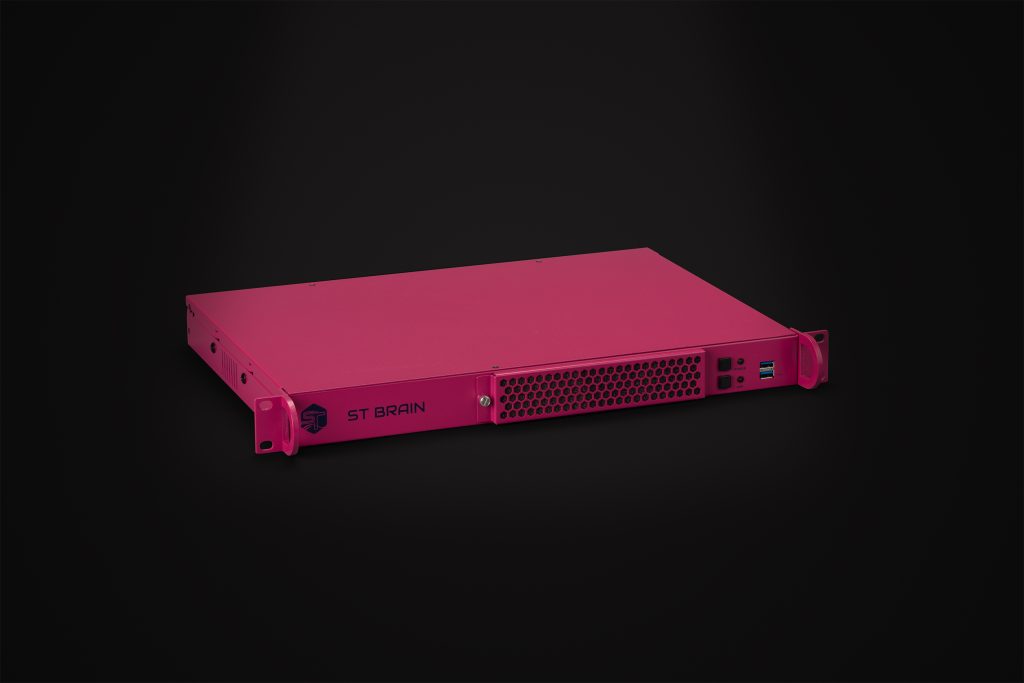
ST BRAIN can be explained quite simply: it is the vessel’s data box, but directly accessible. ST BRAIN forms the digital data platform for inland shipping, giving vessel owners and fleet managers access to vessel data anytime and anywhere. But it does not stop there. With valuable data, many more applications become possible.
From the start, it was clear that the strength of ST BRAIN was not only in collecting data, but especially in unlocking, standardising and translating it into useful insights. This made ST BRAIN more than a technical solution. It became the foundation where safety, monitoring, analysis and future automation come together.
Technically, this was far from simple. In inland shipping, no two vessels are the same. Equipment varies from ship to ship, suppliers work with different standards, and engine data in particular often proved difficult to make available in a clear and consistent way. This was one of the biggest challenges in the early years: how do you turn a huge variety of systems into one scalable and reliable platform?
That step was crucial. Only when data comes in uniformly can it be visualised, analysed and used in a recognisable way, both on board and on shore. In recent years, the ST Team has therefore focused on developing ST BRAIN into a solution that can be used on more and more types of inland vessels. Today, the solution can be applied to practically all inland vessels.
“Today’s data is what we use for tomorrow’s autonomy.”
Remco Pikaart
Where does ST BRAIN stand today?
Today, ST BRAIN is a scalable and ready to use platform on board that works with existing nautical equipment and remains fully functional. In combination with ST SAILING, ST BRAIN can control the vessel’s rudder without needing a constant internet connection. The system provides real time insight into performance, fuel consumption and vessel status, with direct access to the ST Dashboard. This means the data is not only used for the autonomous future, but also for daily operations.
ST BRAIN also supports applications such as ST SAILING, ST EMISSIONS and ST CONNECT. Operational and emissions reports are available at the touch of a button, while historical data can be used for incident analysis and training. In this way, ST BRAIN supports data driven decisions on board and on shore, and forms a reliable foundation for further digitalisation in inland shipping.
This development has already had a significant impact in practice. Incidents can be reconstructed more quickly and situations can be analysed more effectively. This not only makes processes more efficient, but also helps vessels return to operation faster when time and clarity are essential.
“With Shipping Technology, we make inland shipping safer, more sustainable and more efficient.”
David Woudenberg
The future
The next step for Shipping Technology is clear: to continue building the central data platform for inland shipping, on board and across the entire chain. This future is not about technology for its own sake, but about concrete progress for the sector.
That means we will continue to invest in our autonomous roadmap, while also making daily operations smarter. An important part of this is Just In Time Sailing. By connecting engine management to the planning systems of terminals and other chain partners, a vessel can sail more accurately and arrive at exactly the right moment. Not too early, not too late, but right on time. This creates more predictability in the logistics chain, reduces waiting times and lowers fuel consumption.
There is also great potential in sharing vessel data with the wider chain through ST CONNECT. By linking data to maintenance systems and loading and unloading processes, we can further reduce the workload on board and better support operational processes. Digitalisation is not a goal in itself, but the foundation for a more efficient and future proof inland shipping sector.
We are not building that future alone. Collaboration with other parties in the sector is essential. Only by creating smart connections between systems, people and processes can we build the platform that enables inland shipping to truly move forward.
Shipping Technology was not founded simply on the question of what is technically possible. We started with the question of what the sector needs. And that is still where our strength lies: developing technology that already adds value today, while paving the way for the inland shipping of tomorrow.